
This tool can be checked too often
If you find yourself counting again a few minutes later, and again after that, it has stopped being a measurement and become a way to manage the feeling. A tenth count answers nothing the third one did not.
Count the Thunder
Flash‑to‑thunder calculator
When you see lightning, tap. Then tap again when you hear the thunder.
Two taps. No location needed, nothing to install.
An estimate, not an all-clear, and no substitute for official warnings. Terms.
Your last few counts
For anyone frightened of storms. Understanding for the ones that are only loud, and a plan for the ones that are not.
Part one
You are in it right now.
The measurement
Light reaches you instantly. Sound takes about five seconds per mile. So the gap between flash and rumble is a measurement, not a guess. This is the five second rule: count the seconds, divide by five, that is the distance in miles.
You learn where the storm actually is, which is usually further off than it feels. And you have something to do, which is often the more useful half.
That is why it works with a frightened child. Counting is a job and it is theirs. Keep the split: the counting is theirs, the judging is yours. A child left to weigh the danger has been handed the part that feeds the fear.
Thunder within thirty seconds of the flash means the storm is about six miles out. Close enough to be in range.
Wait half an hour after the last thunder. A large share of lightning injuries happen to people who went out when the storm looked finished.
If you find yourself counting again a few minutes later, and again after that, it has stopped being a measurement and become a way to manage the feeling. A tenth count answers nothing the third one did not.
The feeling
Pounding heart, shaking hands, tight chest, a stomach that has dropped. That is adrenaline, and panic does not damage a healthy body.
It runs out on its own. A storm keeps sending new surges, so still shaking forty minutes in does not mean anything has gone wrong.
This page will not tell you it is definitely just nerves. Chest pain, pain down an arm, or simply not being sure: treat that as a medical question and call a doctor or emergency services.
In for four, out for six or eight, for a minute or two. The long out-breath does the work. It will not make the storm quieter. It shortens the climb down.
Shaking is muscle primed to move with nowhere to go. Supported back and feet on the floor give it something to push against.
Sounds
A bolt is miles long, so sound from the far end arrives after sound from the near end. Rolling is distance, not danger.
Close. Stay inside, away from windows, plumbing, and anything plugged in.
Usually the worst is behind you. It can also fall between two lines of storms, so check before going out.
Straight-line winds, far more common than tornadoes. Whichever it is, you do the same thing: go to the place on your plan.
Loud out of all proportion to its size. Most hail is small. Keep away from skylights.
Part two
Most of the fear is not knowing.
Two words
Conditions are right somewhere across a large area over the next several hours. A watch covers many more people than it ends up affecting. Read the plan, charge a phone, bring in what is loose. Then get on with your day.
Radar or a spotter has seen it. Small area, short window, usually under an hour. Go to the place on your plan. Take your phone and your shoes. Stay until it is lifted, not until it sounds quieter.
A severe thunderstorm warning means damaging wind or large hail. It is not a lesser tornado warning, and the winds can do the same damage. A tornado warning means go now, without checking the window first.
Reference
Formation
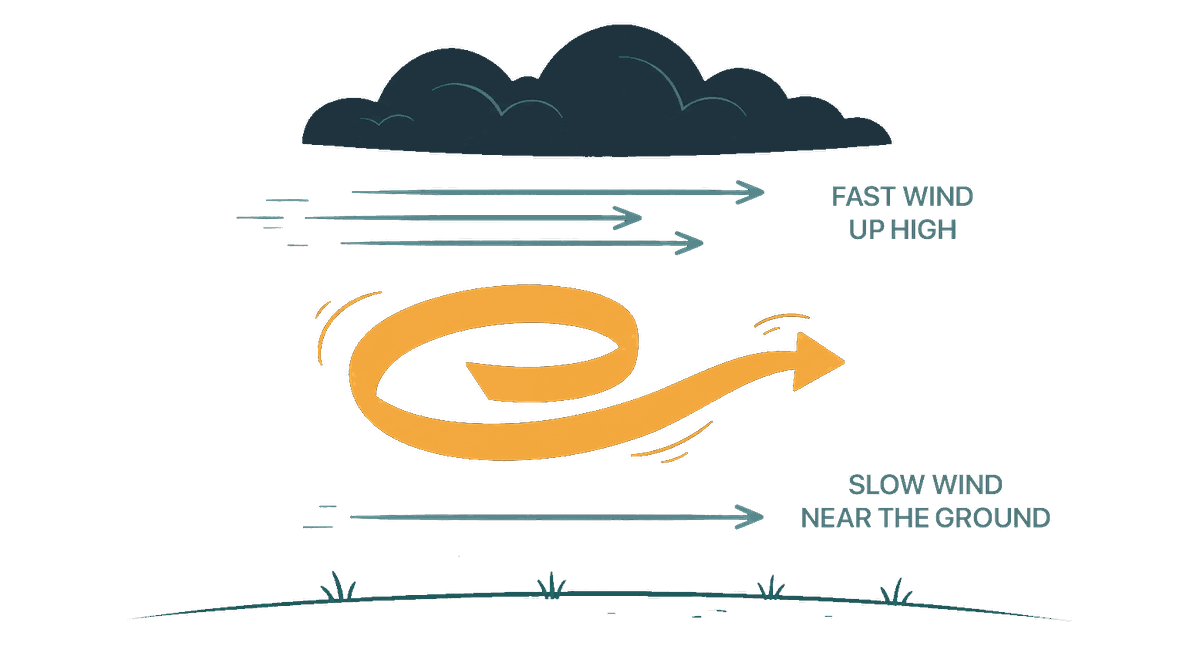
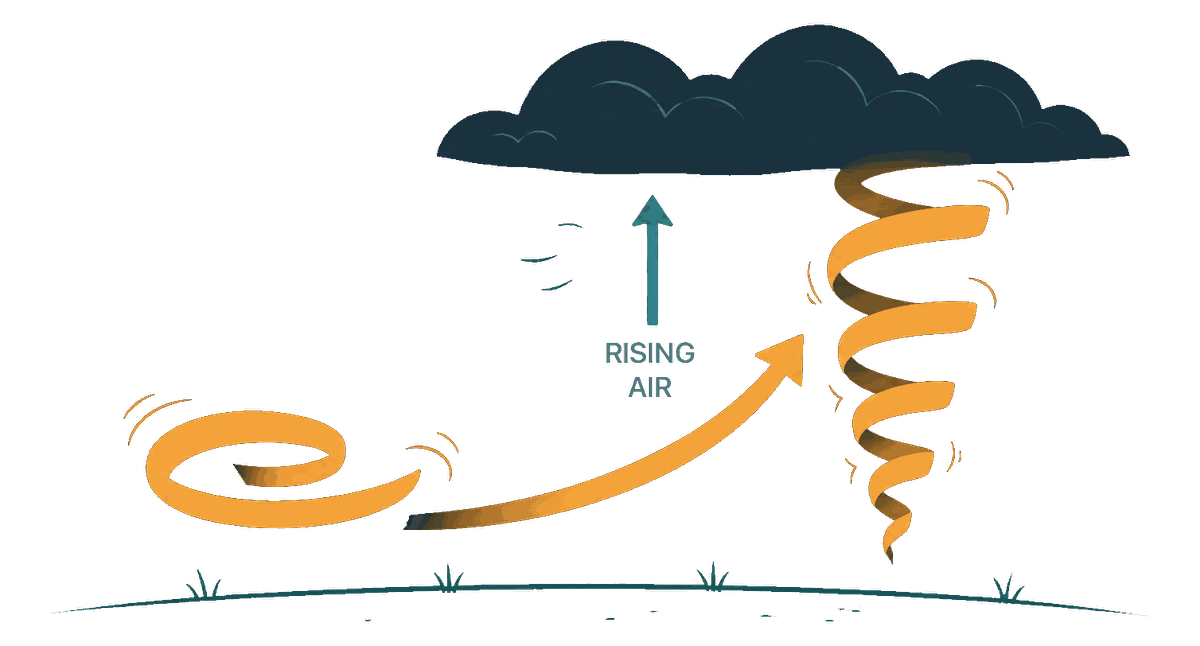
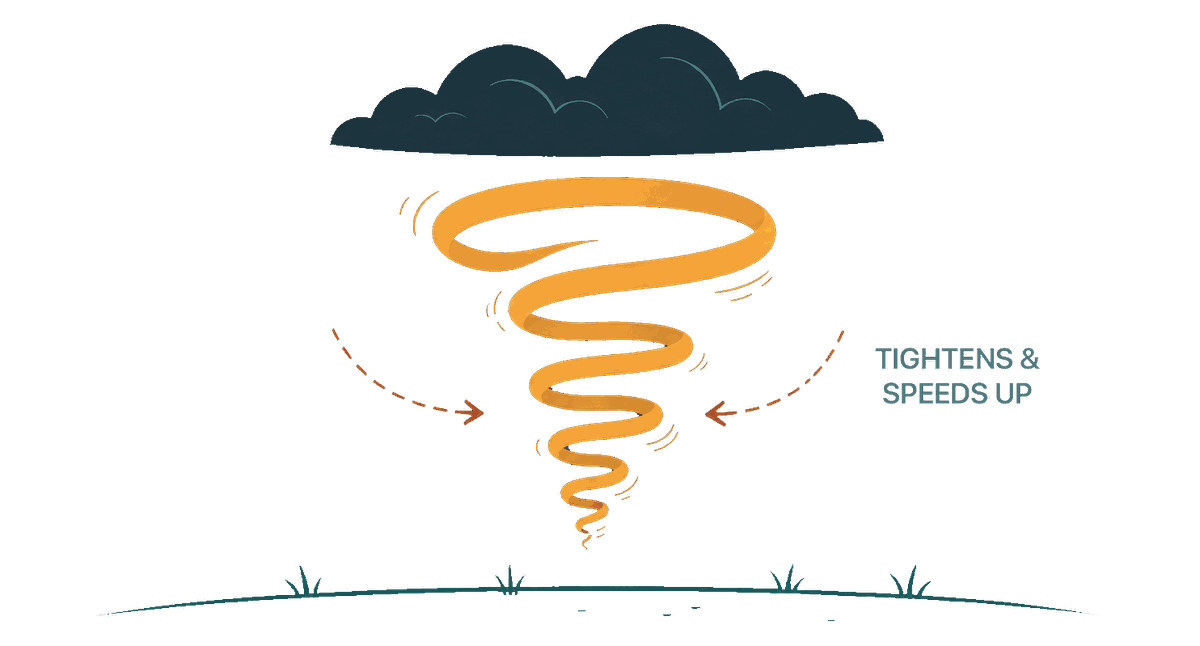
Not random, not sudden. Three things have to line up in order, and most storms never get past the first.
One
Faster wind up high than down low rolls the air between into a horizontal tube, like a pencil spinning across a desk. This happens constantly and does nothing on its own.
Two
A strong updraft lifts the middle of that tube and stands it on end. Radar sees this, which is where most of the warning time comes from.
Three
Air sinking at the back of the storm squeezes the column narrower, and anything spinning speeds up as it tightens. If it reaches the ground, that is a tornado.
This is why forecasters can say days ahead that a Thursday looks capable, and why a warning is a small area for a short time rather than a whole state all night.
Screens
For many people, yes. Seeing where a storm is, which way it is moving, and when it clears turns open-ended dread into something with an end time. For others it becomes the problem. The difference is not the app. It is what happens after you look.
Look once. If you feel settled, radar is helping. If you open it again a few minutes later, and again, it has become a way to manage the feeling, and that makes the feeling stronger over time.
National Weather Service warnings reach your phone on their own. Leave those switched on. A phone that buzzes all evening is usually a weather app's own extra notifications, separate from the official alerts.
They show how hard it is raining, not how dangerous a storm is. A big red blob is not automatically the one to worry about, and a modest-looking cell can be the one that gets warned. Color is a rainfall scale, not a threat scale.
Velocity views take real training to read, and hunting for tornadoes yourself is a fast route to seeing one in every storm. That job is already being done, and the result arrives as a warning.
If you know you are a checker it is reasonable to skip radar entirely, but only once phone alerts or a weather radio are set up to reach you, because you may not always receive a warning.
Part three
Do this on a clear day. Deciding while frightened is the hard way.
Equipment
Categories, not brands. Nothing here is sponsored and there are no links.
Program it to your county. It works when the power is out and the towers are congested, which is exactly when a phone alert does not arrive.
Free, probably already on. Check once.
Broken glass is the injury nobody plans for.
A whistle carries further than a voice.
Outages outlast storms.
The plan
Writing it down now, in good weather, is the single most effective thing on this page.
What you type is saved on your device only, in your browser. It is never sent anywhere. Clearing your browser data erases it, so print a copy. Some of it is about other people, a neighbor or a relative's number, so treat the printout accordingly.
Lowest floor, middle of the building, no windows.
Head injury is what actually hurts people, and most families already own bike helmets.
One source, not five. Five is how you end up refreshing all night.
Mobile homes and RVs are not safe in high wind, whatever they are anchored to. Pick the sturdy building you will drive to before a watch is issued, not during one. In a car, get into a real building.
Two places, in case the neighborhood itself is closed off.
Everyone checks in with the same person, and it should be someone far away. Local lines jam first. Text rather than call.
Carrier or leash, and where it lives so nobody is hunting for it.
Someone in the house, or a neighbor who would not hear a warning.
Nothing filled in yet.
A finished plan fits on one page. When these are answered you are done. Read it out loud with everyone once. A plan nobody has heard is just a piece of paper.
A warning means go now. A watch means get ready. Official alerts: weather.gov
Part four
If storms are a bigger thing in your life than one loud evening.
The name for it
Fear of thunder and lightning is astraphobia, in the same family as fear of heights and deep water.
Better than most fears, and better the earlier it is addressed. The usual approach is exposure-based cognitive behavioral therapy: learning how storms work, then getting comfortable a step at a time with someone guiding the steps. Those are the words to use when you ask for it. Exposure therapy, or CBT for a specific phobia.
Dread for days before a forecast rather than during the storm. Avoiding travel or going outside. Losing sleep on nights nothing happens. Checking you cannot stop.
All of this is information, not medical advice or treatment. If any of it sounds like you, a doctor is a good person to say so to.
Go to the source
The National Weather Service is where every app and channel ultimately gets its information, free and direct. If you bookmark one page about storms, make it one of these rather than this one.
About
I was the kid this page is for. I prayed every night there wouldn't be a tornado while I slept. When the sky went that particular color I was already on my way to the basement.
What helped was learning how storms worked. Once I could read the sky, the anxiety stopped happening to me. That was enough for me. It is not enough for everyone, and there is no shame in needing more than a page like this.
I still watch storms. These days I make a game called RadarWrangler, where you catch storms on live radar. Same instinct to understand and take control, thirty years later.
I hope it is some use to you on a loud night.
— Paul S.
Works with no signal once opened. To keep it on your phone: iPhone, tap Share then Add to Home Screen. Android, use your browser's menu and choose Install.